 English
 اللغة العربية
  Bahasa Indonesia
  日本語
日本語  Bahasa Melayu
  ภาษาไทย
  Tiếng Việt
  简体中文
简体中文 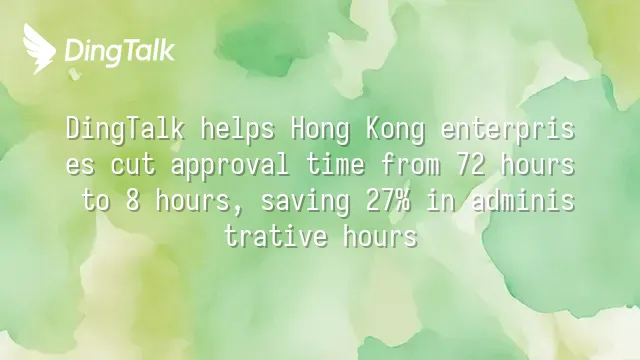
Why Traditional Communication Is Holding Your Team Back
Sixty percent of Hong Kong's corporate employees admit to wasting nearly five hours each week tracking tasks and repeatedly confirming details—not due to laziness, but because they're using the wrong tools. When critical information is scattered across emails, group chats, and paper-based meeting minutes, miscommunication becomes the norm. One logistics company only discovered conflicting specifications two weeks after implementing automated scheduling, simply because requirements were spread across three different channels. This outdated communication structure directly kills agility and innovation.
The real issue isn't a lack of communication, but rather "communication without traceability and execution without connection." When instructions can't be traced and responsibilities are unclear, management turns into firefighting. DingTalk doesn't just fix tooling problems—it rebuilds the foundation of collaborative trust: every message can become an action, and every interaction leaves an auditable trail.
How DingTalk Resets Enterprise Collaboration Logic
DingTalk’s value isn’t in having endless features, but in integrating communication, approvals, attendance, and project management into a single platform. DingTalk OS supports modular deployment—retailers can quickly apply standard shift scheduling workflows, while manufacturers can customize production dashboards and integrate them with ERP systems. This means you no longer need to wait for IT departments to develop dedicated systems; business units can configure their own workflows independently.
Its localized server infrastructure and optimized communication protocols enable cross-border collaboration that’s 37% faster on average than Slack and 19% more stable than Teams. More importantly, behavioral design elements like “read/unread” status and synchronized task lists reduce follow-up costs through transparency and minimize blame-shifting by clarifying ownership. After implementation, one logistics firm reduced interdepartmental collaboration cycles by 42%, as everyone was finally working from the same page.
The Numbers Don't Lie: Real Operational Gains Revealed
A Hong Kong retail group cut approval processes from 72 hours to just 8 after adopting DingTalk, reducing administrative workload by 27%. This isn’t just about saving time—it enhances business agility: inventory adjustments happen faster, and customer experience improves. Tracking three key metrics, they found meeting resolution execution rose from 43% to 79%, project timelines shortened by 35% on average, and daily repetitive communication dropped by 1.2 hours per employee.
Beneath these gains lie hidden dividends: error correction time fell by 60%, and interdepartmental email exchanges dropped by over 80%. According to their internal ROI model, the first year’s savings in unproductive hours equated to 14 full-time employees. More crucially, units with higher digital collaboration maturity saw a 41% reduction in quarterly performance volatility—smoother information flow leads to smaller execution gaps and more predictable strategy implementation.
SME Transformation Can Actually Be Simple
Small and medium enterprises often fear transformation will take too much time and manpower, but in reality, basic deployment can be completed within four weeks. Week one involves uploading the organizational structure and setting permissions to ensure information flows securely and complies with governance standards. Weeks two and three focus on digitizing three core processes—leave applications, procurement, and work orders—using small-scale pilots to validate effectiveness. In week four, migrate data from WhatsApp Business, leveraging built-in audit logs to verify completeness and prevent data loss.
One cross-border logistics company piloted warehouse dispatch scheduling and achieved a 68% reduction in processing time, while also detecting fleet delay trends in real time. This "quick feedback → full rollout" approach transforms digital adoption from a long-term investment into an immediate operational upgrade—one that requires no additional IT staff and can even be led directly by the business owner.
The Next Step in the AI Era: From Collaboration to Prediction
Once companies complete their cloud-based collaboration upgrade, the real competition begins: who can embed AI into everyday decision-making? The DingTalk AI Assistant can now automatically generate meeting summaries, predict project risks, and even recommend resource allocation. A simple command like “schedule the sales meeting for next Wednesday” triggers a full workflow—including calendar coordination, room booking, document preparation, and post-meeting follow-ups.
This capability is powered by deep integration with Alibaba Cloud’s Tongyi Qianwen, enabling natural language control over enterprise processes. According to a 2024 Asia-Pacific report, such AI automation frees up over 150 hours annually for senior executives in decision preparation—nearly a month of full-time productivity. Future competitiveness won’t depend on whether you have the tools, but on how quickly your systems learn to think.
We dedicated to serving clients with professional DingTalk solutions. If you'd like to learn more about DingTalk platform applications, feel free to contact our online customer service or email at
Using DingTalk: Before & After
Before
- × Team Chaos: Team members are all busy with their own tasks, standards are inconsistent, and the more communication there is, the more chaotic things become, leading to decreased motivation.
- × Info Silos: Important information is scattered across WhatsApp/group chats, emails, Excel spreadsheets, and numerous apps, often resulting in lost, missed, or misdirected messages.
- × Manual Workflow: Tasks are still handled manually: approvals, scheduling, repair requests, store visits, and reports are all slow, hindering frontline responsiveness.
- × Admin Burden: Clocking in, leave requests, overtime, and payroll are handled in different systems or calculated using spreadsheets, leading to time-consuming statistics and errors.
After
- ✓ Unified Platform: By using a unified platform to bring people and tasks together, communication flows smoothly, collaboration improves, and turnover rates are more easily reduced.
- ✓ Official Channel: Information has an "official channel": whoever is entitled to see it can see it, it can be tracked and reviewed, and there's no fear of messages being skipped.
- ✓ Digital Agility: Processes run online: approvals are faster, tasks are clearer, and store/on-site feedback is more timely, directly improving overall efficiency.
- ✓ Automated HR: Clocking in, leave requests, and overtime are automatically summarized, and attendance reports can be exported with one click for easy payroll calculation.
Operate smarter, spend less
Streamline ops, reduce costs, and keep HQ and frontline in sync—all in one platform.
9.5x
Operational efficiency
72%
Cost savings
35%
Faster team syncs
Want to a Free Trial? Please book our Demo meeting with our AI specilist as below link:
https://www.dingtalk-global.com/contact
