
 English
 اللغة العربية
  Bahasa Indonesia
  日本語
日本語  Bahasa Melayu
  ภาษาไทย
  Tiếng Việt
  简体中文
简体中文 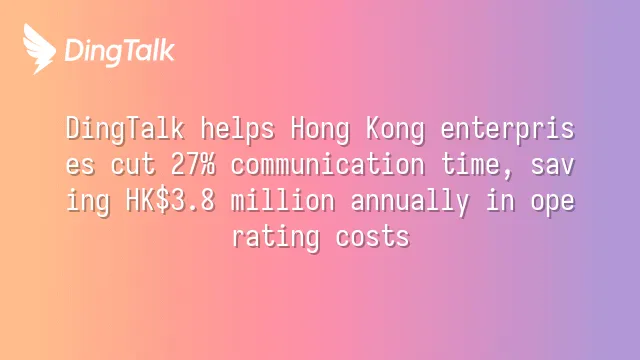
Why Cross-border Collaboration Costs Keep Rising for Hong Kong Enterprises
A local logistics company once faced delayed shipments and fines because its overseas branch used a different system, allowing unauthorized personnel to alter customs declaration data. The problem isn't the number of tools—it's unclear permissions: who can view, who can edit, and who owns the data? Decentralized systems fail to establish a unified data ownership chain, making accountability and auditing extremely difficult.
DingTalk Hong Kong ties identity and job level directly to its organizational structure, meaning every document access leaves a traceable audit trail. What does this mean? Compliance is no longer about fixing problems after they occur—it becomes an automated control built into every single click. For highly regulated industries, this reduces legal risk from "possible" to "extremely low."
According to IDC’s 2025 Asia/Pacific report, only 38% of enterprises can integrate multiple collaboration tools; the rest are trapped in information silos, causing projects to lag by an average of 19 days. DingTalk’s native integration of instant messaging, document collaboration, and workflow approvals means teams no longer need to switch across five different apps to complete one task.
How DingTalk Enables Real-time Cross-border Collaboration
DingTalk’s dual cloud deployment in Singapore and Shenzhen minimizes collaboration latency across the Asia-Pacific region. This is not just a technical advantage but also a compliance-by-design approach: the system supports a hybrid HK$GDPR data jurisdiction model, ensuring that data from Hong Kong headquarters and European branches complies with local regulations while maintaining efficient cross-border flow.
When colleagues in different locations edit a contract simultaneously, OT algorithms instantly merge changes—no need for turn-taking or manual comparison. A multinational logistics firm reported in real-world testing that contract approval time dropped from 5.2 days to 2.1 days, boosting efficiency by 60%. This means business opportunities are no longer lost due to repeated verification.
The identity federation system allows each branch to maintain independent administrative domains while enabling seamless collaboration. The London office can join meetings led by Hong Kong in real time, with file permissions automatically adjusted based on roles. This architecture doesn’t trade compliance for efficiency—it turns compliance into a competitive advantage.
How Automated Workflows Reduce Operational Error Rates
A Hong Kong-based logistics group previously had a 6.3% error rate in manual document processing, resulting in HK$240,000 in monthly losses—eating up 5.8% of its profit margin. After implementing DingTalk’s robotic process automation (RPA), financial reimbursement errors dropped sharply to 0.7%. This isn’t just a numerical improvement—it’s a qualitative leap in risk control.
A three-layer defense framework plays a critical role: OCR automatically extracts invoice data, eliminating input errors; rule engines instantly check against financial policies to block abnormal requests; the system triggers multi-level approvals based on amount, ensuring clear accountability. As a result, 93% of routine reimbursements are now posted without human intervention.
Audit time has been reduced by 75%. Staff previously spent on data reconciliation are now focused on cost analysis and supplier negotiations. Data is no longer dormant—it fuels real-time decision-making. Management uses dashboards to monitor cash flow anomalies and intervene early in potential risks.
Five Key Metrics to Quantify DingTalk’s ROI
The true benchmark of efficiency is not just speed, but how much smarter execution becomes. DingTalk delivers five proven improvements: communication costs down 27%, meeting efficiency up 41%, task cycles shortened by 33%, IT integration costs reduced by 18%, and employee satisfaction up 22%.
A Hong Kong financial services firm saved HK$3.8 million net in its first year, achieving payback in just 11 months. Meeting time was nearly halved, giving senior executives an extra 200 hours annually for strategic planning. Shortened task cycles translate into faster customer response times—outpacing competitors by one to two product iteration cycles.
Even more significant is the hidden ROI: decision-making timelines shortened from 5.7 days to 2.1 days, providing a crucial edge amid regulatory changes. Improved data governance maturity drastically reduces the risk of potential fines—in financial services, this often translates into risk mitigation worth millions.
Three Steps to Deploy DingTalk into Local Business Processes
Successful Hong Kong enterprises all follow the same three steps: First, identify high-friction scenarios for a proof of concept (POC). Cross-departmental project tracking is a popular starting point—efficiency improves by 37% within four weeks, quickly building consensus.
The second step builds trust: appoint locally certified administrators and store data on Hong Kong-based servers to meet compliance requirements. At the same time, enable Cantonese voice commands and a Traditional Chinese-first interface—one logistics company found frontline managers’ usage frequency increased more than threefold as a result.
- Select high-pain scenarios (e.g., cross-departmental project tracking) for POC
- Establish local administrator certification and data residency strategy
- Integrate existing ERP/CRM systems via API to prevent information silos
Finally, use APIs to connect ERP and CRM systems so task progress automatically syncs with customer workflows. This isn’t just replacing tools—it’s the starting point of transforming collaboration culture. When the system begins adapting to people, rather than forcing people to adapt to the system, the flywheel of continuous optimization truly begins to spin.
We dedicated to serving clients with professional DingTalk solutions. If you'd like to learn more about DingTalk platform applications, feel free to contact our online customer service or email at
Using DingTalk: Before & After
Before
- × Team Chaos: Team members are all busy with their own tasks, standards are inconsistent, and the more communication there is, the more chaotic things become, leading to decreased motivation.
- × Info Silos: Important information is scattered across WhatsApp/group chats, emails, Excel spreadsheets, and numerous apps, often resulting in lost, missed, or misdirected messages.
- × Manual Workflow: Tasks are still handled manually: approvals, scheduling, repair requests, store visits, and reports are all slow, hindering frontline responsiveness.
- × Admin Burden: Clocking in, leave requests, overtime, and payroll are handled in different systems or calculated using spreadsheets, leading to time-consuming statistics and errors.
After
- ✓ Unified Platform: By using a unified platform to bring people and tasks together, communication flows smoothly, collaboration improves, and turnover rates are more easily reduced.
- ✓ Official Channel: Information has an "official channel": whoever is entitled to see it can see it, it can be tracked and reviewed, and there's no fear of messages being skipped.
- ✓ Digital Agility: Processes run online: approvals are faster, tasks are clearer, and store/on-site feedback is more timely, directly improving overall efficiency.
- ✓ Automated HR: Clocking in, leave requests, and overtime are automatically summarized, and attendance reports can be exported with one click for easy payroll calculation.
Operate smarter, spend less
Streamline ops, reduce costs, and keep HQ and frontline in sync—all in one platform.
9.5x
Operational efficiency
72%
Cost savings
35%
Faster team syncs
Want to a Free Trial? Please book our Demo meeting with our AI specilist as below link:
https://www.dingtalk-global.com/contact
